

Moose Not Mines
Congress seems ready to let a Chilean billionaire wreck our most visited public wilderness area


The US Senate is one vote away (HJ Res. 140) from ending a 20-year ban on mining in and around the Boundary Waters Wilderness. I, and so many people I know and love, would find the destruction of this beloved wilderness devastating. So, briefly, I'll talk about the mine, and the ruin it will cause, and then to close, I will refocus on what we stand to lose if we lose the Boundary Waters. I didn't think my voice alone was up to such a grand refocusing, so I am including some reflections on the Boundary Waters by friends of mine that I have collected in recent days.1
If you are reading this and know and love the Boundary Waters, please join the reflection pool—leave a comment about your history with them and why you want them protected!
The impending vote in the Senate is the culmination of a backdoor loophole effort to overturn a years long environmental review process that involved peer-reviewed research and massive community outreach. This vote would go against the will of the people. The most recent poll I could find (by Impact Research, from August 2025) found that "68% of voters statewide and 70% of voters in battleground districts say that legislation permanently protecting the Boundary Waters from sulfide-ore copper mining should be a very important priority." This finding is consistent with polls done by Trump's own favored polling firm Fabrizio-Ward.
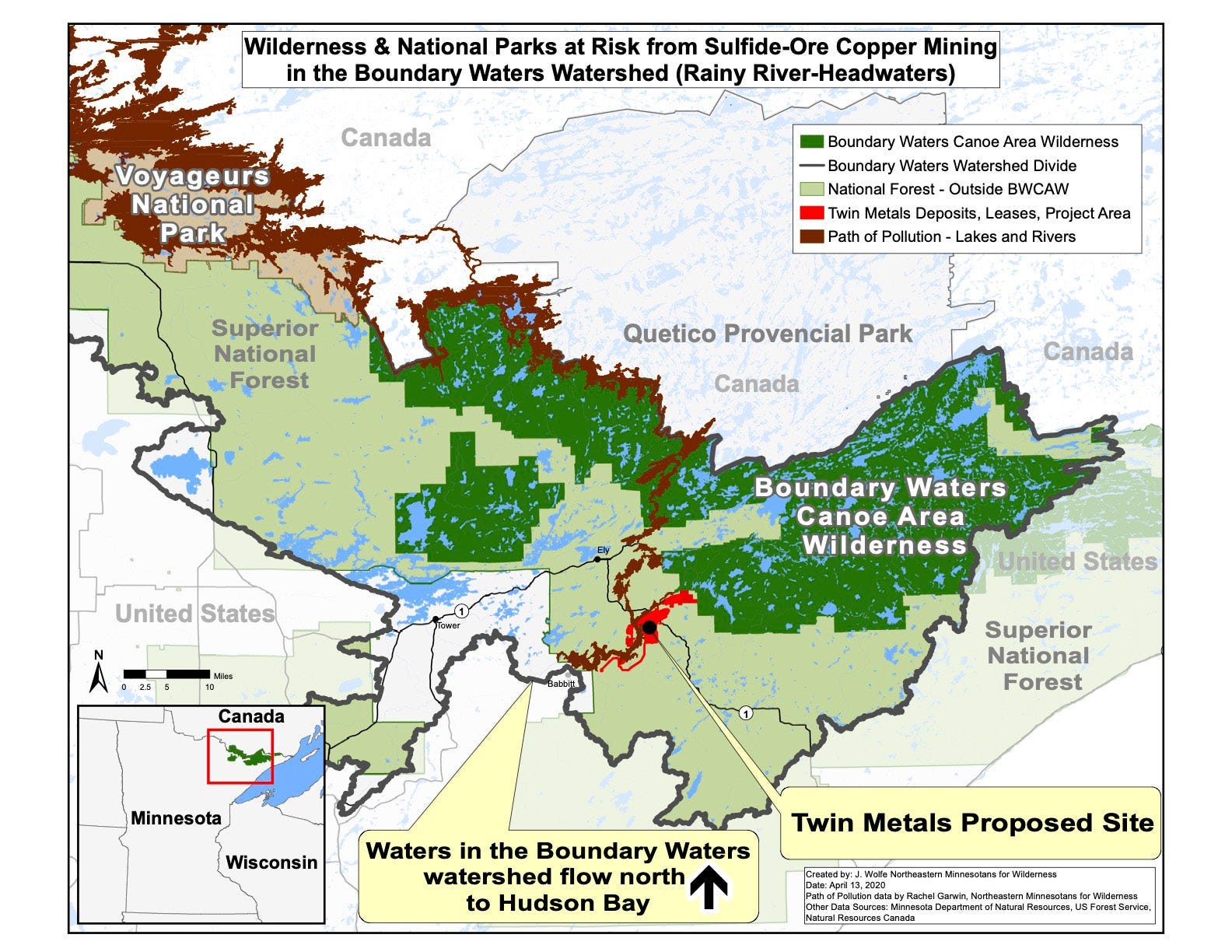
If the ban is overturned, the Antofagasta Conglomerate, a chilean company, owned by a chilean billionaire, will use its disguise subsidiary Twin Metals Minnesota to begin sulfide ore mining just outside of the Boundary Waters, directly upstream of them.2 The map below shows the path pollution from the proposed mine will take as it travels north into the Boundary Waters watershed.
Sulfide ore mining is particularly damaging. To get at trace amount of copper and nickel, vast amounts of sulfuric acid will be released into the Boundary Waters. Sulfuric acid is battery acid. Exposure to it can cause extreme burns; it is the substance used to eat rust away in industrial steel production. It can cause blindness if the eyes come into contact with it, whether through the air or via splash. It can induce tissue and organ death if ingested, say while drinking water that once was the cleanest water on earth.
Twin Metals claims that "ore processing will remove most of the sulfide minerals. Therefore, tailings will not produce acid rock drainage (ARD)." They also claim that "the project design we have today minimizes potential impacts in the areas of water, wetlands, noise, dust, light and visual pollution." The first claim is a blatant lie. This type of mining has never "not produced acid rock drainage." This type of mine has, historically, polluted surrounding waters 100% of the time it has been tried. Closed sulfide ore mines are still polluting this country right now as I write. Today, 50,000 gallons of contaminated sulfuric-acid-laden waste water will spill out of long closed sulfide ore mines. Will Antofagasta stick around for 85 years after they abandon this site to ensure that their actions don't harm future inhabitants of Northern Minnesota? For the 250,000 years during which, some estimates say, the site will still be dangerous? I cannot call the second claim a lie. They are shifty like that, this foreign mining company. It's phrased so as to be technically possible. But the phrasing is also telling. Antofagasta only cares about "visual pollution." So they will hide their mine underground and pretend that if we can't see the harm it is doing, then that harm doesn't exist.
Republicans who are voting in favor of the mine repeat their age old platitude that this is about jobs. Representative Pete Stauber (R-MN) said as much on the floor of Congress—“these are good mining jobs,” he said. But by Twin Metals' own estimation, only around 750 direct jobs will be created by this mine. And perhaps 1,000 more will be created indirectly. But they do not mention that mining jobs are inherently temporary. On their website, they acknowledge their mine will close when it is no longer profitable to destroy the Boundary Waters, but they say nothing of what will happen to the miners who will be laid off. It's worth remembering that this has happened before in Minnesota. In the 1980s 10,000 miners lost their jobs when the iron mines closed. Most of those miners found new livelihoods in the recreation industry which now gives upwards of 17,000 people jobs in the Boundary Waters and Superior National Forest alone. That's 17,000 jobs that rely on these waters being pristine, that will be threatened by the existence of mining here. As always, it's not really about creating jobs for normal Minnesotans. It's about paving the way for corporations to get rich off of our public lands. Plundering that which we hold in common for the benefit of all, and for the health of the planet, so that a chilean billionaire can add a few billion to his bullion pile.
What do we Stand to Lose?
What is it that would be destroyed by the sulfuric acid that will leach out of this mine? A place of solace; a place of rest; a place of clear waters—some of the cleanest left on earth; countless fauna would not survive the acid—moose and loons, fish innumerable, Canada lynx, gray wolves, black bears, and the critically-threatened long-eared bat. The Boundary Waters hold 20% of our National Forest’s fresh water. A quarter of a million people canoe through them every summer. Tens of thousands of rural livelihoods are sustained by work supporting the recreation that goes on within these waters. And on the other side of the boundary? The Canadians have already permanently banned mining in their half of these waters—Quetico Provincial Park. They understand how important and pristine this place is, and how valuable and increasingly rare such places are. This mine would destroy Quetico across the boundary as well. The US Senate will not just be undoing the will of the people of Minnesota, but of Canadians too.
So to close, here is a small sampling of those people who do not want this mine, who love the boundary waters, and all that they represent. I am very grateful for their responses and I hope somehow they might move the far-away senators who will make this decision, as they have moved me.
My friend Annie Schlaefer wrote: “I grew up going to the boundary waters with my family. It is the first place I felt deep connection to the earth. The first place someone told me that I could dip my waterbottle in the middle of the lake and drink the water. I could trust the upstream decisions hadn’t poisoned what flows to me. It is where I learned about leave no trace and what it means to take with me only what I need. This place helped me and so many others shape our understanding of our relationship to the land- not as something to use up- but something to belong to and be accountable to.
To me the BWCA is a symbol of truly protected and cared for land and water. Proof that restraint is possible and not everything has to be optimized for extraction or profit. If we give into capitalism in a place so loved and cared for like the BWCA, it really feels like there could be no end to the ravaging of capitalism.”
My friend Kristi Fackel wrote: “We sent August [Kristi’s son] to a camp where they take (increasingly) long trips into the Boundary Waters, and he left home the first time a sullen, long-haired (hair as curtain-shield that he could disappear behind) kid and returned a different human. His hair was behind his ears, his smile was genuine and he was filled with a confidence that came from having met his edges.”
My friend Claire Roth relayed some thoughts to me over the phone; here is my rough retelling of what she said based on the notes I took while we chatted: The first time I went camping was in the Boundary Waters when I was twelve. I grew up in Los Angeles so this was my first time really going into the woods. The trip was five days long and there were seven girls and two counselors on it. We carried ourselves physically but we also carried each other’s souls, our energies, we empowered each other. It was the first time that I realized I could do things I set out to do, and that I could have community while doing those things. It was the first time I heard a loon. It was the first time I felt grounded in a community that was empowering, and that was life changing. [Claire has since worked as a counselor on trips like the ones she went on, passing on the empowerment she felt back then to kids now.]
My fiancé (!) Kyra Smith wrote: “I didn’t know a place such as the boundary waters existed until I was an adult. Canoeing in the boundary waters was the first time I experienced extended silence. That silence opened up worlds and wells of gratitude for this beautiful earth within me. It is a sanctuary away from all evils where one can dream of a better world.”
And my friend Johan Cavert wrote: “I grew up going to the Boundary Waters with my extended family every year. It was a tradition that shaped my understanding of wilderness, of beauty, of the hardiness and fragility of nature, and of the sublime feelings of community and satisfaction one can reach after a long day’s paddle and a sing around the campfire at night.”
HJ Res. 140 remains before the Senate today. With just one vote, the senate could overturn the ban, and allow mining to proceed in Minnesota, against—it must be stressed again—the will of the people. The people have already spoken; that was what led to the ban in the first place. Haven’t we had enough of billionaires profiting to the detriment of absolutely everyone else? So call your senators! Call Rep. Pete Stauber [(202) 225-6211)] and give him a piece of your mind. You can find your senator’s phone number here. Here’s what I’ve been putting on the back on my “Moose Not Mines” print:
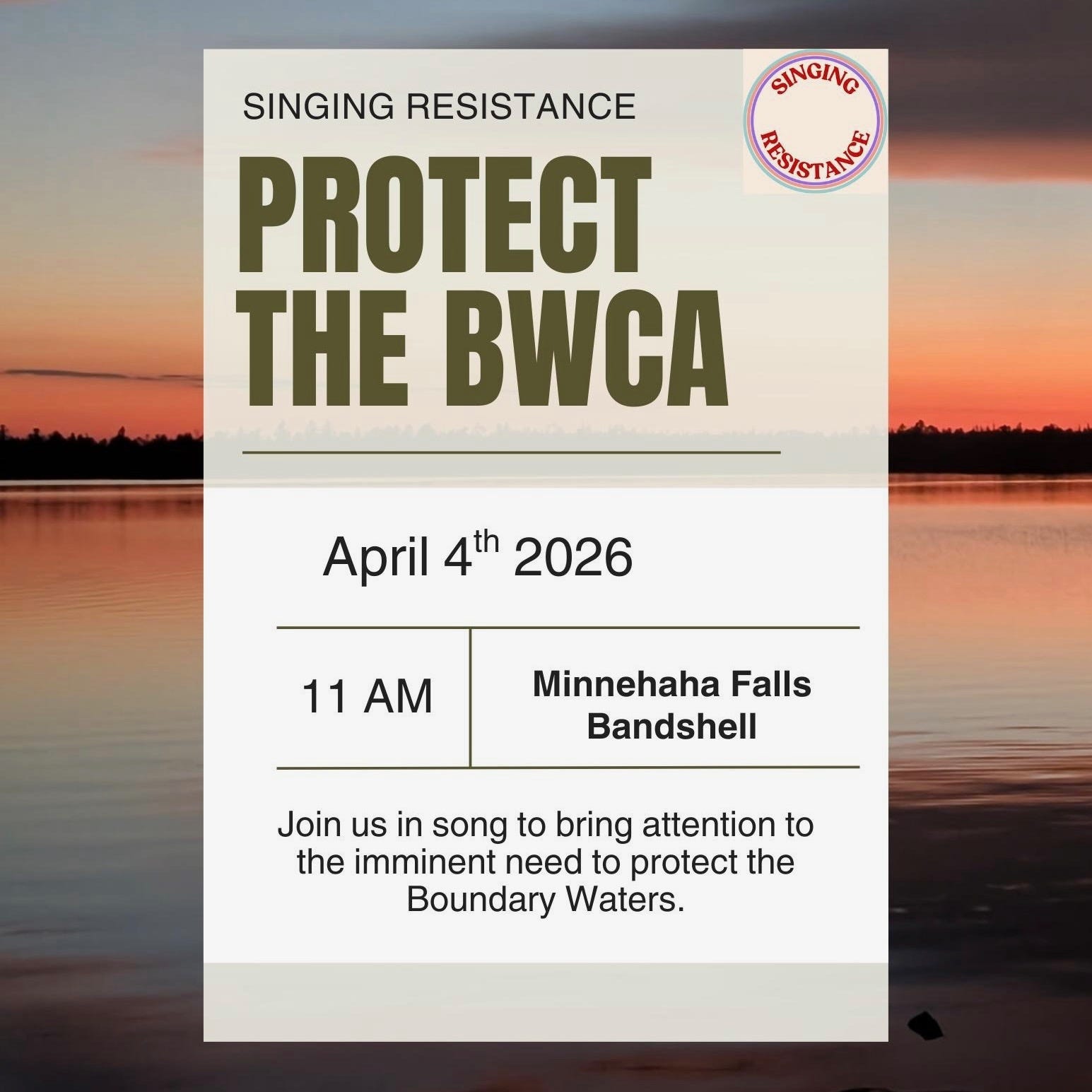
And one last thing! If you live in Minnesota and would like to protest the Antofagasta Mine in person you can! This Saturday April 4th, at 11am, my aforementioned friend Claire is organizing a singing protest action at the Minnehaha Falls Bandshell in Minneapolis. If you go, you’ll get a paper copy of this print, along with much fun singing, community, and you could even wear a cardboard canoe around your waist as you dance!
One of the more eloquent defenses of the Boundary Waters I’ve seen is coming not from a Minnesotan representative, but from Rep. Jared Hoffman of California. You can find a transcript of his speech on the floor of the House here.
Why overturn the will of the people? Could it be . . . dareisay . . . a bribe? Shortly after Ivanka Trump and Jared Kushner began renting a DC mansion from the chilean billionaire in question, Andrónico Luksic, at less than market value, the Trump Administration moved to overturn the ban on mining which was holding up Mr. Luksic’s sulfide ore extraction plans. All parties involved claim this is a coincidence.