

Letter from Greenville, SC
In which the bridge curves and the dismantling is not complete

I was heartened to realize upon reaching Greenville after my sojourn in Europe that the purposes I set forth last week for this newsletter1 would be instructive lodestones after all. Greenville, on its surface, holds small panaceas abounding, reified2 and potential. Greenville also reads as something of a mystery. There is much room in this place for reading between the lines—for discerning agendas hidden in Main Street’s didactics. And though Greenville has had major success dismantling some misguided mid-twentieth century development projects, I left with the feeling that Greenville’s dismantling is not complete. As Kyra & I drove on from Greenville we asked ourselves the ever pertinent question—who was all this dismantling for?
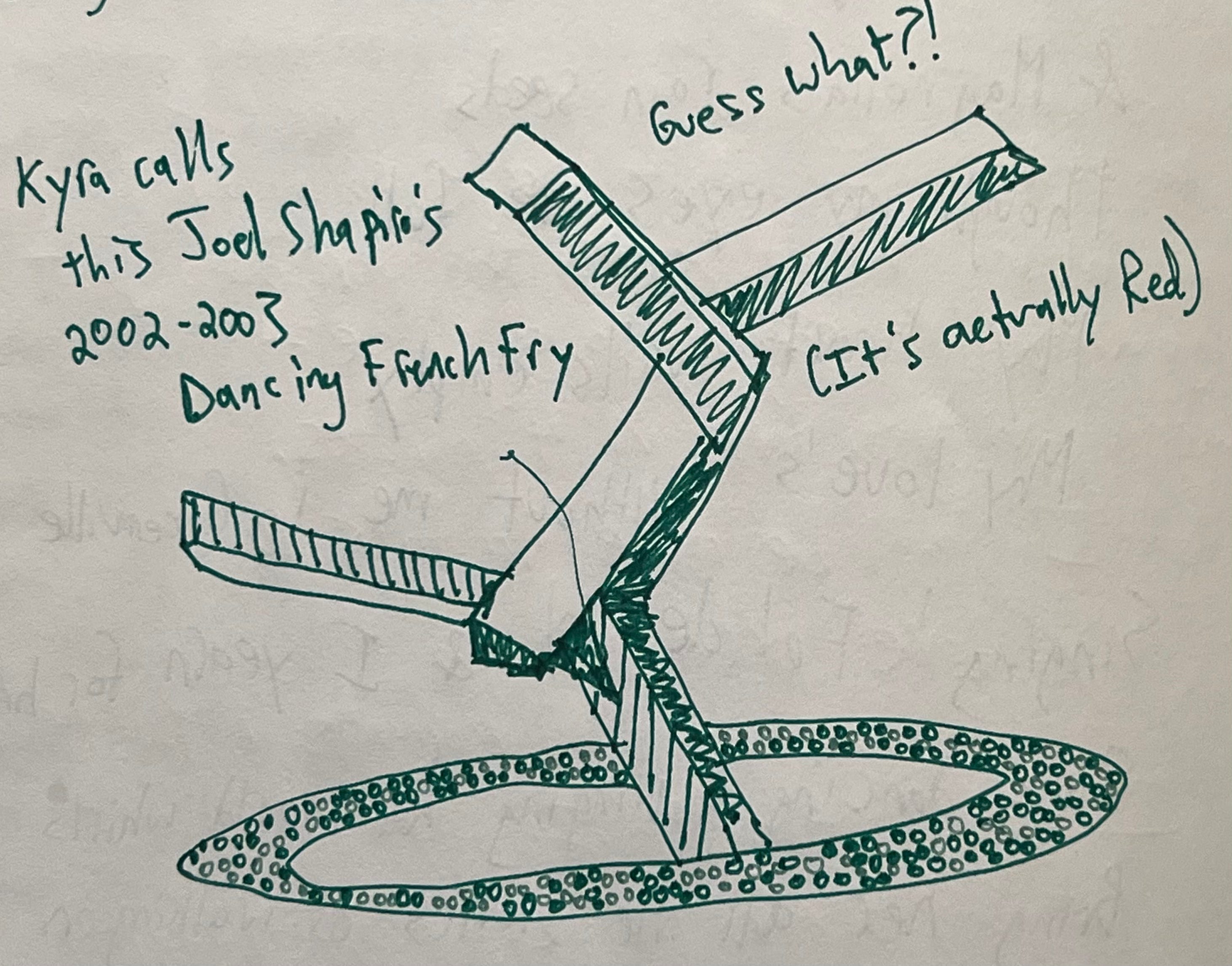
On the morning after I arrived in Greenville, after a long southbound drive through some delightfully wooded passages of North Carolina which would have made Robert Moses shudder with glee at how his parkway concept was catching on the country over, we ventured down Main Street to where the Reedy River plummets over a small waterfall ledge, splashing onto limestone boulders tinged red by clay. Kyra & I smiled broadly for the splendor of this beauty hardly out of sight of the theatre she’d be heading into later. We laughed too for Kyra quipped that the Joel Shapiro sculpture before us as we looked out on the falls was rather like a dancing french fry!
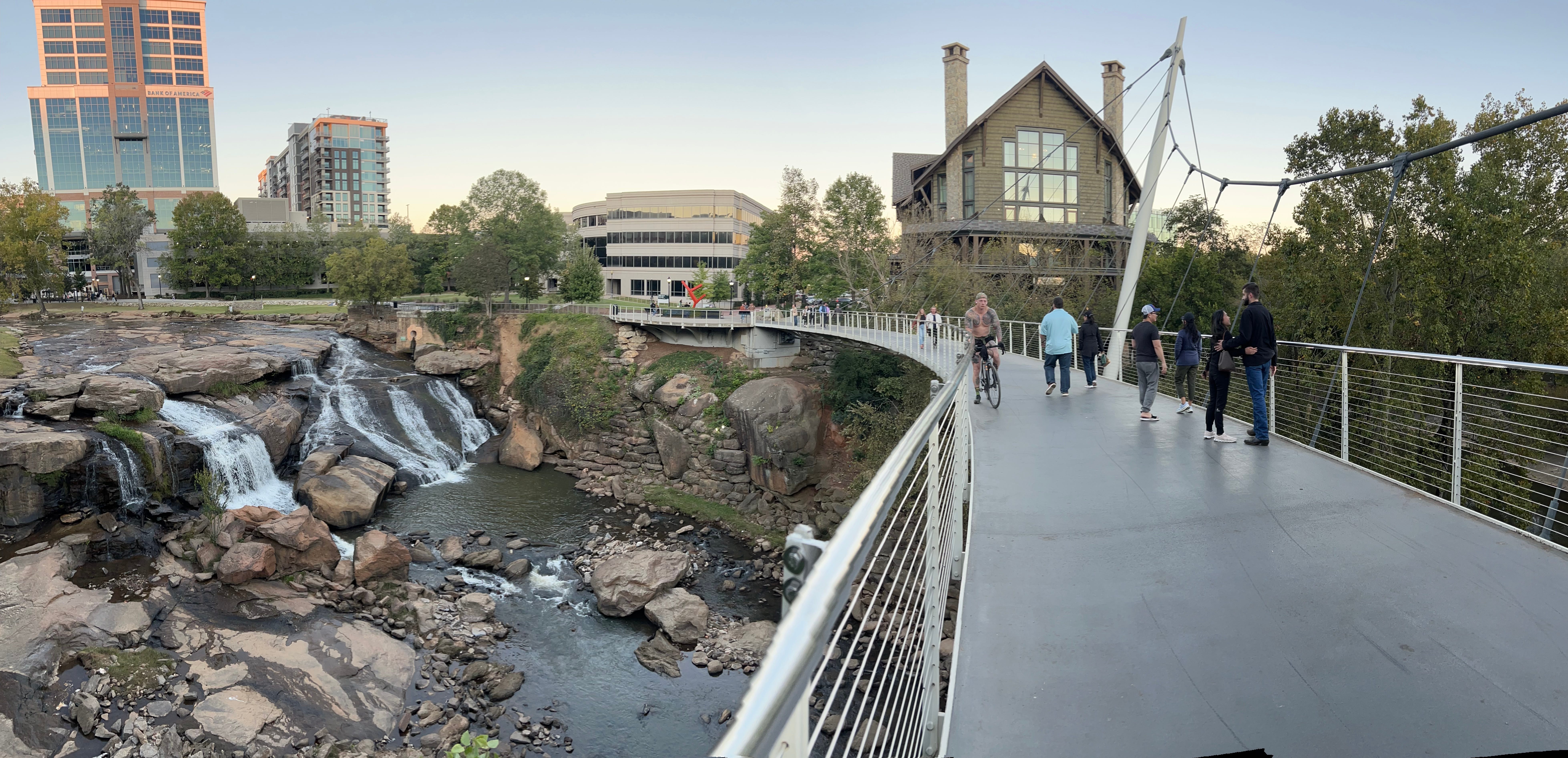
And then we looked up and our smiles widened! For wrapping around our sight, spreading its sloping deck ahead of us, was the Liberty Bridge. If the falls make one half of a circle’s broad arc, the curvilinear seven inch thick white deck of the pedestrian bridge offers to complete the circle’s circumference. Together, falls and bridge, form a disc which seems to float gently above the river’s rush. As if apart from the flow for a moment, the bridge embraces the falls as its cables sweep the sky like a simple carousel of lines and space. The cables and the “two 28 ton tubular masts”3 which support them are all inclined away from the falls, and notably adorn only the outside edge of the bridge’s curve. The bridge is thus a small odeon for walkers to stop a while and gaze on the falls with an utterly unobstructed view. Kyra & I stood and stared. And we were happy to simply stand in the presence of bridge and falls embracing.
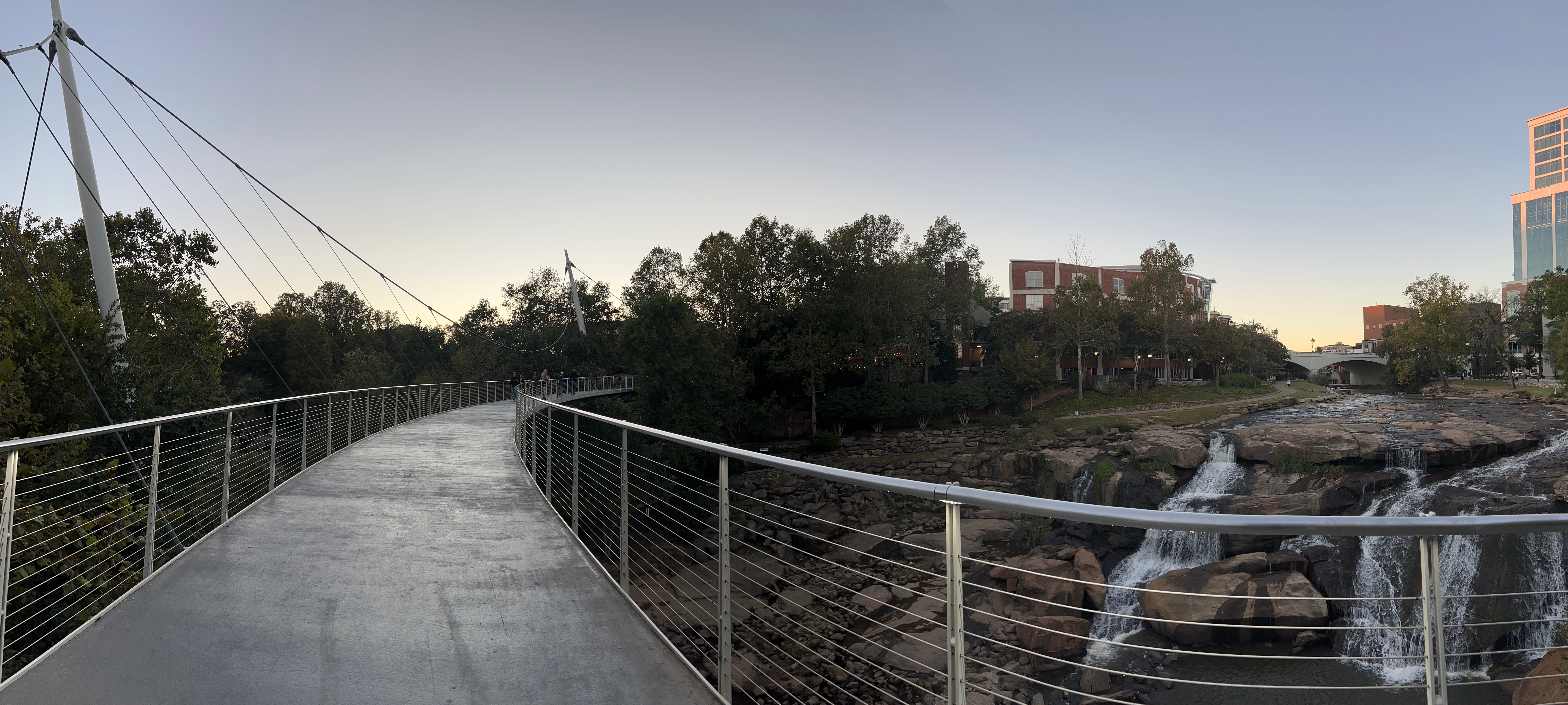
And this is just what Miguel Rosales, the architect behind the bridge, intended—bridge as amphitheater for waterfall reflection.4 The Liberty Bridge is the only curvilinear suspension bridge in the United States. Greenville is the only place in the country you can walk a parabola’s form suspended 50 feet5 above a river! I have come to love the gentle slope up, and after reaching small hill’s zenith the quick steps which bring me down again as I cross over the suspension bridge type with which I am familiar. I came to love a wholly new motion as I ran suspended over the falls on this curvilinear bridge—the mild tug in my calf as I tended to my right running westbound over a flat curve, ever so gently upwards with each bound!
And as I looked into the bridge more, my smile continued to broaden—here in city’s center was manifest dismantling (of some form) in action! In 2001 the Greenville City Council voted to create this curving wonder, not from scratch, but as part of a $13 million initiative6 to realize the longstanding plans for the not yet completed Falls Park. These plans included removing the Camperdown Highway Bridge which had been built just south of the falls in 1960, completely obscuring them from drivers passing through and partially obscuring them from pedestrians everywhere. Many residents of Downton Greenville in the 70s and 80s were not even aware that they lived within walking distance of a waterfall.7 Instead they were familiar with four lanes of the State Highway 20 overpass.
The falls, and Reedy River before the highway bridge was built, were already in a sorry state. By the early 1900s the textile industry, largely established in Greenville by the slave owner Vardry McBee, who built his first mill in 1829 within sight of where Liberty Bridge floats today, had polluted the river and desolated the falls so badly that it seemed like the highway bridge covering up the murky brown water was actually doing Greenville a favor.
There were those however who remembered the falls, and knew of the falls’ historical importance to Greenville as a gathering site and the surroundings as a place for rest and relaxation. Almost as soon as the Camperdown Bridge opened, the Carolina Foothills Garden Club began thinking of how to return the falls to their previous yet long declining splendor. In 1967 the Garden Club succeeded in lobbying Furman University to deed 6 acres of their original campus to the city of Greenville for a Reedy River Falls Historic Park.8
The women who embarked on this nearly 35 year journey to remove the Camperdown Highway bridge went about convincing Greenville to deconstruct with a page right out of Robert Moses’ playbook. They decided early to frame the fight as a battle to create a park. Moses did the same when he was building parks on Long Island in the 1920s, despite the well-funded litigious protests of the Robber Barons on whose land he was encroaching, saying to associates for years afterwards, “as long as you are fighting for parks, you can be sure of having public opinion on your side, you’re safe.”9 This would serve Moses well for four decades, and it would serve the women of the Garden Club well too.
Later when they had convinced the Mayor of Greenville, Knox White, who is still in office today and has served since 1995, that tearing the bridge down was necessary for the full realization of their park dream “he encountered crossed arms and dour faces when speaking at public gatherings about tearing down the bridge. Why tear down something that works?”10 But then Mayor White began showing the unconvinced a postcard, printed by former city parks director Paul Ellis, with a painted rendering of a beautiful green park replete with a curved pedestrian bridge giving an amphitheater-like view of the newly revealed falls. The tide of public opinion began to shift. Who can oppose a park?
Throughout the 1970s the women of the Garden Club took steps to expand the idea of the park in the imaginary of Greenville. By 1973 they had their little six acre park listed on the National Register of Historic Places. And by 1976 they had restored Falls Cottage, a small house from the 1890s which they placed as a gate at park’s entrance, thus starting to position the park as a destination in the city’s consciousness.11 These actions coincided with the mayoralty of Max Heller, who is often referred to in Greenville didactics and in the Greenville News as “the patron saint of the city’s downtown renaissance.”12 Heller began to implement action items on the city’s downtown development plan almost as soon as he took office in 1971.
Here is where things get a little bit murky. To clear up the story my research would need to expand into talking with the actual people who remember. But this newsletter is a small panacea, and so, for now, because we’ve already moved on from Greenville, I’ll make do with the paper sourcing I’ve got. (You really can find a lot on the internet these days by golly! In the course of researching this I found all the Colonial Records for South Carolina from 1754-1797 scanned and uploaded!) Perhaps our longer stints in some of the places we visit will afford opportunities for this type of more involved research!
Here’s the confusion—it appears that this downtown development plan was initiated in 1968 by the Carolina Foothills Garden Club as a second prong to their actual goal of building a park surrounding the falls. However, I cannot determine if the development plan the city adopted under Max Heller was the Garden Club’s plan—which they had the County Planning Commission Director Bert A. Winterbottom13 draw up—or if the city used the Garden Club’s plan in creating their own very similar plan. Regardless, it is clear that the Garden Club had some influence by this point which makes further sense once the identities of the women in the Carolina Foothills Garden Club are revealed.
Once Heller took office, the development of downtown and the creation of Falls Park went hand in hand. For so did the women of the club and the developers. The wealthy husbands of three prominent Garden Club members largely financed the endowment for the park, and the planning that preceded the Camperdown’s removal and the Liberty Bridge’s construction. They did so because they knew that making Greenville a tourist destination would be good for their businesses and the businesses they sponsored. They also sponsored the development of downtown Greenville.
Harriet Smith Wyche, was married to lawyer Tommy Wyche14 whose firm was one of the park endowments largest donors. Minor Mickel was married to Buck Mickel,15 whose Daniel-Mickel Foundation was another major donor to the park planning endowment.16 Anna Kate Hipp, named on the garden club website as someone who simply “helped raise funds” for the park and bridge endowment, is the wife of W. Hayne Hipp,17 the owner of Liberty Corporation which donated $500,000 to the endowment in order to secure the naming rights for the bridge—hence The Liberty Bridge.18 Has the ring of something decidedly untrademarked though, eh?
All this is to say that following the money is a fun exercise in reading local newspapers, and leads me back to the question Kyra & I found ourselves asking as we were moving on from Greenville. The manifest dismantling that has happened in Greenville is wonderful. It is a shining example of what can be done in this country and what needs to be done, but as it currently stands, who is this dismantling serving?
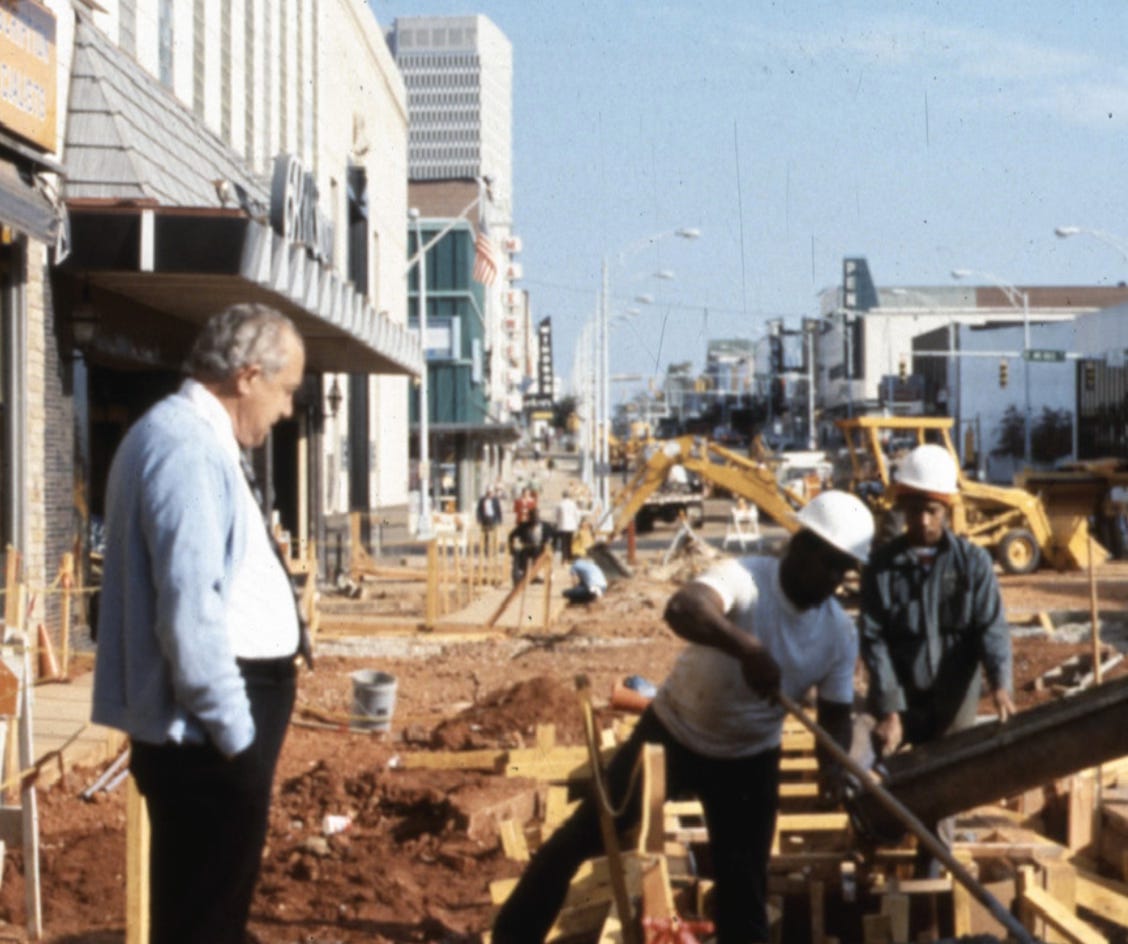
A closer look into what changed during Heller’s mayoralty reveals who—largely white owned businesses along a Main Street rebuilt to be friendly to tourism. In 1979, as Max Heller was leaving office, he began a dismantling project of his own. As the Garden Club had suggested, Main Street was narrowed from four lanes to two,19 and the sidewalks were widened to accommodate more pedestrians—or consumers rather. Trees were planted, and more light fixtures were added.20 Max Heller then joined forces with two of the aforementioned husbands, Tommy Wyche and Buck Mickel “to create one of the most powerful trinities of local servanthood the city [had] seen. With Mickel’s gregarious salesmanship, Wyche’s legal mindset and Heller’s political connections, the trio changed the face of downtown, joining others to form Heritage Green, land the Hyatt Regency, forge Riverplace, build the Peace Center [where Kyra and the show performed this week!] and more.”21
I am not suggesting that these men wanted a park and the restoration of the falls purely because it was good for business. Tommy Wyche in particular was a conservationist as well as a businessman. He wrote the “South Carolina Heritage Trust Act, the South Carolina Conservation Easement Act and the South Carolina Mountain Ridge Protection Act”22 which led to the conservation of close to 100,000 acres including the Jocassee Gorges, the watersheds of Table Rock and Poinsett Reservoirs, and the land stretching between the two reservoirs which is now known by the name Wyche used for them—The Mountain Bridge Wilderness Area. I am suggesting that dismantling and lucrative business can be mutually agreeable goals.
This vision of Wyche, Heller, and Mickel for a prosperous, ‘safe’, and enticing downtown Greenville—a “Downtown Reborn,” as the city puts it—was a vision created by, and for white people. The seeds of this “Downtown Reborn” were sown during a period stained by White Greenville’s extreme hesitancy to integrate during the late 1950s and throughout the entirety of the 1960s. Desegregation in Greenville happened very slowly.23 Tommy Wyche’s uncle, the Federal Judge C.C. Wyche24 denied Thurgood Marshall’s attempt to desegregate the public library after students at Sterling High School led a study-in there in 1960.25 Threat of federal action after Judge Wyche denied Marshall’s injunction motion led the library to slowly start a policy of non-discrimination. Greenville delayed integrating its school system for a full sixteen years after Brown v. Board of Education; it wasn’t until 1969 when the Supreme Court ruled in Alexander v. Holmes County Board of Education that “the obligation of every school district is to terminate dual systems at once and to operate now and hereafter only unitary systems,”26 that Greenville set a date for integration.
When it did finally happen on February 17, 1970, the process was much easier for white children than for black children. Sixty percent of the district’s black children were reassigned to new schools while only ten percent of white children were forced to move. Black children “shouldered 75 percent of the busing burden.”27
And when it was forced by the Federal Government to change, Greenville dismantled black institutions as it desegregated. Both formerly all black high schools, Sterling High and Lincoln High, were closed. Sterling High School, before it was closed,28 was about a five minute walk from where the Liberty Bridge and the falls embrace today. It was a source of pride in the black community of Greenville for 74 years. And it was too close to the ‘perfect’ downtown Greenville that white Greenville business men—Heller, Wyche, Mickel, and more— were creating. Stephen O’Neill writes eloquently towards the end of his article “Memory, History, and the Desegregation of Greenville,”
Greenville’s white leadership was indeed moved by law: law challenged by the civil disobedience of young [black] protestors; law argued by attorneys Smith, Sampson, Perry, Marshall, and Greenberg; law overturned in federal courts. White Greenville was also moved by sincere concern for the community and its reputation. And because reputation was closely tied to an inviting climate for business investment, Greenville was moved by a concern for money. White Greenville was not moved by a desire for justice or a spirit of equality.29
Blacks recall the arrests, the resistance of the white establishment, the court victories, the indignities they faced in fighting for rights guaranteed by the Constitution. Whites usually remember ‘working together for integration,’ the interracial cooperation of the chamber of commerce committee, the ‘grace and style’ of the enormous effort to dismantle peacefully an old system of racially divided schools in order to build a new racially unified system. These memories of white Greenville and especially the memories of the chamber's biracial committee have formed the basis for most written accounts of the events. For whites looking back there is a feeling of self-congratulation that is incomprehensible to blacks who lived through that period. Perhaps Greenville’s tradition of civic boosterism compels whites to remember selectively and to mythologize those events in ways that continue to enhance Greenville’s reputation as a good place to live and invest. On the other hand, ongoing racial tensions in Greenville during the post-civil rights years remind us that selective memories and self-serving myths are a poor foundation on which to build a community of justice and equality.30
Because White Greenville continues to selectively remember its past, the dismantling here is incomplete. This was evident even before I began reading academic articles about how. When strolling down Main Street, Kyra & I came across didactics and a few bronze sculptural portraits of prominent Greenville citizens from over the years which left some huge details out.
On the corner of the street named for him, McBee Avenue, a life-size bronze sculpture of Vardry McBee mentions that he was an inspirational citizen of Greenville who did much to bring the textile industry to the city in the early 1800s and to begin to turn Greenville into an economic hub. It does not mention that he owned 56 slaves.31
A plaque by the falls dedicated to Robert Pearis, for whom Paris Mountain twenty minutes north of Greenville is named, proudly posits that Pearis is Greenville’s founder, first inhabitant (??!!), and an even earlier driver of Greenville’s economic growth. It fails to mention that he owned twelve slaves, and by one account tricked some Tsalagi leaders into signing away their ancestral land by getting them drunk.32
In front of the Poinsett Hotel is a bronze sculpture of its namesake Joel Roberts Poinsett, the 15th Secretary of War, and the botanist who introduced poinsettias to the United States.33 They are named after him in English—he grew them here in Greenville and spent the last decade of his life on his farm nearby. The didactic at the foot of his sculpture does not mention that he owned over 100 slaves on that farm, that he carried out the Trail of Tears as Secretary of War, and that he meddled in a Mexican Presidential election in 1829, supporting a coup of the democratically elected President who then had to flee the country.34 Sounds eerily familiar to our ears now.
Even the much more recent sculpture of Max Heller notes with pride that Heller was the man to desegregrate the city departments of Greenville—in 1971 (??!!), a full six years after the Civil Rights Act was passed.
Desegregation did not come easily here; Greenville could begin to right this wrong by dismantling the sculptures of McBee, Pearis, and Poinsett, and renaming or restoring the original names of places named for them. We should give poinsettias a better name too while we’re at it. The Garden Club has proven good at getting things dismantled in Greenville—perhaps they could draw up some plans to continue this work. And I’ll continue my story of their (with hope first) success.
Nothing can be successfully dismantled, or built, without plans drawn up. By 1990 the women of the Carolina Foothills Garden Club, empowered by the almost $3 million endowment they had raised—mostly from their husbands—had hired landscape architect Andrea Mains to design a comprehensive plan for the full 26 acre park. Mains was the first to advocate for a new pedestrian bridge from which the falls could be seen unobstructed, and she removed the Camperdown Bridge from the site, if only on paper, for the first time.35 By this point the Garden Club husbands had developed much of Main Street. The Peace Center, envisioned by the Garden Club, and talked about by Heller for years, was built in 1991 with funding from Wyche, Mickel, and the Peace Family. The Hyatt Regency put Greenville on the map of the country’s convention culture. The Bi-Lo Center and the aforementioned Poinsett Hotel were added in the mid, and late 90s respectively.
When the money became available, the Garden Club’s plans for the park were ready to go. Did the women in the Garden Club read about this strategy in The Power Broker when it was published in 1974? Their foresight is reminiscent of a textbook Moses move. Just as Mayor Fiorello La Guardia was to realize that “a key reason for Moses’ success in obtaining federal money was that Moses had plans for huge public works ready at the moment the money became available,”36 Mayor Knox White realized that he could use the plans already drawn up by the Garden Club to convince the last hold outs for keeping the Camperdown Bridge that the aesthetic appeal of a novel bridge in Greenville would cement its place as a growing tourist and business center. He had only to help concerned citizens visualize what the falls and the curvilinear bridge could add to the already well under way “Downtown Reborn” project using Paul Ellis’ beautiful postcard rendering.
And so in 2001, after nearly 35 years of Garden Club hinting and planning, the City Council finally voted to tear down the Camperdown Highway Bridge. With Miguel Rosales’ plans for the new pedestrian bridge already complete when the money became available, dismantling and new construction came one after the other. And by 2004, the Liberty Bridge, certainly a small panacea, and deservedly so, was open to the public.37
Lest we selectively remember, the Camperdown Highway Bridge is far from the only thing Greenville has dismantled. On the corner of Spring Street and Washington Street across from the hotel we stayed in, a sculpture of the great one-legged tap dancer Peg Leg Bates, beautifully welded out of polished nuts and bolts, with his arm swooping an arc over his shoulder that might make the Liberty Bridge itself jealous if it were trying to tap dance too, seems a better representative than I to ask who is all this dismantling for?
The Liberty Theatre (no relation to the corporation) opened on this corner in 1919.38 A movie and vaudeville theatre for black entertainers, it was a gathering space and community hub for the black residents of Greenville through the years of segregation and Jim Crow. Peg Leg Bates was discovered here in 1926, and went on to perform on Broadway in 1949. He graced Ed Sullivan’s stage 22 times starting in 1953. But by the end of the 1960s Greenville was beginning its ‘more friendly to business’ rebirth, and the Liberty Theatre was torn down in 1970 to make room for a parking garage.
The Show’s Goings On: Kyra debuted her first two tracks last week in Durham, North Carolina. One of them was amid show swing on—Kyra got ready in a flash after the second number and went on because someone got mildly injured—they are back in action now! Yay Kyra! Debut Day! Nicole, one of the other swings, and our dear friend, debuted her first track, as Lucy on Thursday and then debuted another track almost right away, going on as Lady Capulet/Nell on Saturday! Yay! Congrats Nicole! With that all the Swings have touched the stage! Lois has has crushed it as Juliet a few times now but still has to debut her dancing tracks.
In a fun surprise visit, the union rep watched the show this week. And two swing outs—where a Swing goes on for a Dancer but it’s planned, not because someone calls out—went down so that understudies could watch the backstage traffic of the leads that they cover. Always interesting to watch the show from a new perspective, and helps you not get run over when you do a different part for the first time. And Jacques spoke with Stephanie about working merch for the tour—so it seems like he’ll be joining the show next week in Charlotte!
We are in Pittsburgh, PA this week! Next week we are shipping out to Boston for a two week stay—yahoo!
cf. the first edition of this newsletter:

Hard to fit it into this essay but still of note—Kyra & I had a ton of fun finding the 9 bronze mice that are hidden all over Main Street! I found a list of clues in the lobby of the Hyatt at the Northern end of Main Street and off we went searching for Millie and all her friends! In 2000 a high school senior named Jimmy Ryan procured all the funding for them and worked with a Greenville artist, Zan Wells, to get the scavenger hunt created and installed for his senior project—certainly a wee panacea!
Schlaich Bergmann Partner, “Liberty Bridge Greenville,” https://www.sbp.de/en/project/liberty-bridge-greenville/
Says Rosales, "You have cables in the back, and then, you have a completely open view of the waterfall." Citation: Rey Llerena, “Liberty Bridge architect discusses bridge's impact on Greenville, South Carolina, and career,” WYFF4, September 16, 2024: https://www.wyff4.com/article/liberty-bridge-architect-greenville-career/62230285
The Historical Marker Databse, “Liberty Bridge,” https://www.hmdb.org/m.asp?m=169315
City of Greenville, South Carolina, “Downtown Reborn,” https://citygis.greenvillesc.gov/downtownreborn/index.html
Emily Warner, “Liberty Bride celebrates 15th year,” The Greenville Journal, September 12, 2019: https://greenvillejournal.com/community/liberty-bridge-celebrates-15th-year/
The Carolina Foothills Garden Club, “Falls Park History,” https://cfgardenclub.org/falls-park-history/
Robert Caro, The Power Broker (New York: Vintage Books, 1974), 218.
Eric Connor, “Liberty Bridge, Falls Park transformed downtown,” The Greenville News, October 4, 2014: https://www.greenvilleonline.com/story/news/local/2014/10/04/liberty-bridge-falls-park-transformed-downtown/16751269/
The Carolina Foothills Garden Club, “Falls Park History,” https://cfgardenclub.org/falls-park-history/
Staff Obituary, “Max Heller: 1919-2011,” The Greenville Journal, June 16, 2011: https://greenvillejournal.com/news/max-heller-1919-2011/
J. Hunter Stokes, “How Falls Park became one of Greenville’s Crown Jewels,” The Greenville News, May 2, 2018: https://www.greenvilleonline.com/story/news/local/greenville/downtown/2018/05/02/how-falls-park-became-one-greenvilles-crown-jewels/565134002/
Staff, with help from Lynne Lucas and her book Renaissance Man: The Life of Tommy Wyche, “Delve: Beautifying Main Street to the mountains,” The Greenville Journal, February 28, 2020: https://greenvillejournal.com/news/delve-series-wyche-family/
“The Legend: Minor Mickel Shaw,” The Upstate Business Journal, April 29, 2016: https://upstatebusinessjournal.com/profile/the-legend-minor-mickel-shaw/
John Boyanoski, “Liberty Corp. to Sponsor Reedy Falls Bridge,” The Greenville News, September 11, 2003: https://www.newspapers.com/article/the-greenville-news-liberty-corp-to-spo/147692816/
Ibid.
“Downtown Reborn” cf. footnote 5. https://citygis.greenvillesc.gov/downtownreborn/index.html
More light fixtures usually make it harder for unhoused people to sleep. And this was certainly the point. Mayor Knox White refers to derelicts under the Camperdown Bridge on page 80 of his book, “Reimagining Greenville: Building the Best Downtown in America.” Mayor Knox White also once told the Greenville News that the Camperdown Bridge had become “ a haven where thieves and robbers would flee after committing a crime:” https://www.greenvilleonline.com/story/news/local/2014/10/04/liberty-bridge-falls-park-transformed-downtown/16751269/
Stephanie Trotter, “From the Ground Up: How the Mickel and Daniel families helped form the foundation for today’s Greenville,” The Greenville Journal, August 28, 2020: https://greenvillejournal.com/delve/from-the-ground-up-how-the-mickel-and-daniel-families-helped-form-the-foundation-for-todays-greenville/
C. Thomas “Tommy” Wyche Obituary, Thomas McAfee Funeral Homes, January 23, 2015: https://www.thomasmcafee.com/obituaries/C-Thomas-Tommy-Wyche?obId=31750891; Confirmed in the record of the South Carolina General Assembly, February 1, 2011, “A Senate Resolution to Honor C. Thomas Wyche of Greenville . . .” https://www.scstatehouse.gov/sess119_2011-2012/bills/488.htm
The Greenville Airport was one of the first places to desegregate here, on February 20, 1961, due to a favorable federal court ruling. The ruling only came through on the side of integration because of national scrutiny which resulted after Jackie Robinson was forcibly removed from a white waiting area as he was arriving to speak at a national NAACP conference in 1959. Also notable, Greenville County was the last in South Carolina to adopt MLK Jr. Day as an holiday; it only did so in 2004.
I sourced this familial relation in two places: 1. https://guides.law.sc.edu/MemoryHoldTheDoor-VolumeIV/WycheCyrilGranville and 2. https://ancestors.familysearch.org/en/MY1R-584/judge-charles-cecil-wyche-1885-1966 which has a copy of the relevant page of the 1910 Thirteenth Census of the United States attached which I was able to view.
Burton, Orville Vernon, and Winfred B. Moore, Jr. Toward the Meeting of the Waters: Currents in the Civil Rights Movement of South Carolina during the Twentieth Century. From Stephen O’Neill’s chapter in Part Four, “Memory, History, and the Desegregation of Greenville,” p. 286-299, Columbia: University of South Carolina Press, 2008, 289.
Ibid, 294.
Ibid, 295.
The School building itself burned down two years before the school was closed and I found at least two sources which hinted that this was not an accident. Sterling High was moved to a new building for its final two years of operation. 1. https://www.greenvilleonline.com/story/news/local/greenville-roots/2017/09/15/sterling-high-school-fire/99442538/ and 2. https://sciway3.net/greenville-historical-schools/SCIwaySterling.htm
Burton, 295.
Ibid, 296.
Bruce E. Baker, “McBee, Vardry,” South Carolina Encyclopedia, June 8, 2016: https://www.scencyclopedia.org/sce/entries/mcbee-vardry/
Archie Vernon Huff Jr., Greenville: The History of the City and Country in the South Carolina Piedmont (Greenville County Historical Society: University of South Carolina Press, 1995), 16-17.
James T Hammond, “Poinsett, Joel Roberts,” South Carolina Encyclopedia, June 20, 2016: https://www.scencyclopedia.org/sce/entries/poinsett-joel-roberts/
Lindsay Schakenbach Regele, “Joel Roberts Poinsett: Namesake of the poinsettia, enslaver, secret agent and perpetrator of the ‘Trail of Tears’,” The Conversation, December 19, 2023: https://theconversation.com/joel-roberts-poinsett-namesake-of-the-poinsettia-enslaver-secret-agent-and-perpetrator-of-the-trail-of-tears-219781
Ibid.
Caro, 360.
Connor, 2014—again. Many sources exist with this information though, including the Federal Highway Administration’s write up of the bridge which can be found here: https://highways.dot.gov/public-roads/mayjune-2011/citys-signature-centerpiece
This paragraph sourced from the didactic on the wall next to the sculpture—the full text of which can be found here: https://greenvillemusicpreservation.org/clayton-peg-leg-bates/